Strength Training 3 Days a Week: Build Muscle Fast
The exact programme, the science, and the system busy men use to build muscle in under 3 hours a week.

You don't need to live in the gym to build muscle.
Three well-structured sessions per week — about 2.5 hours of total training time — is enough to build serious strength, add lean mass, and transform your body composition.
This isn't a compromise. It's what the science actually supports. And for busy men juggling careers, families, and everything else, it's the most sustainable path to results that last.
In this guide, you'll get the exact programme, the science behind why it works, and the system to keep progressing week after week.
The Science: Why 3 Days Works
Let's kill the myth first: more gym days do not equal more muscle.
A 2018 meta-analysis in Sports Medicine found no significant difference in hypertrophy between training a muscle group twice versus three or more times per week, as long as weekly training volume was matched (Schoenfeld et al., 2018).
What does that mean in plain English? If you do 10 sets of chest per week across 3 sessions, you'll grow just as much as someone doing 10 sets across 6 sessions.
The key variables for muscle growth are:
- Mechanical tension — lifting heavy enough to challenge the muscle
- Progressive overload — gradually increasing the demand over time
- Training volume — enough weekly sets per muscle group (10–20 sets is the evidence-based range)
- Training proximity to failure — working within 1–3 reps of failure on working sets
None of these require 5–6 sessions per week. Three sessions at 45–50 minutes each give you plenty of volume, adequate frequency, and — critically — enough recovery time between sessions.
Greg Nuckols of Stronger by Science summarised a review of 25 studies and concluded: hitting each muscle group 2–3 times per week is sufficient for maximal growth in natural lifters. Going beyond that doesn't help — it just adds fatigue.
For more on why 3 sessions outperforms 6, see our deep dive: 3 Gym Sessions Per Week vs 6: What Actually Works.
The Programme: Your 3-Day Split
This is a full-body programme using an A/B split. You alternate between two sessions across three days per week.
Example schedule:
- Monday: Session A
- Wednesday: Session B
- Friday: Session A
- The following week: B — A — B. Then repeat.
Session A — Push & Squat Focus
| Exercise | Sets × Reps | Rest |
|---|---|---|
| Barbell Back Squat | 4 × 6 | 2–3 min |
| Barbell Bench Press | 4 × 6 | 2–3 min |
| Barbell Row | 3 × 8 | 90 sec |
| Overhead Press | 3 × 8 | 90 sec |
| Barbell Curl | 2 × 12 | 60 sec |
Session B — Pull & Hinge Focus
| Exercise | Sets × Reps | Rest |
|---|---|---|
| Deadlift | 4 × 5 | 3 min |
| Pull-ups or Lat Pulldown | 4 × 6–8 | 2 min |
| Dumbbell Bench Press | 3 × 10 | 90 sec |
| Leg Press or Bulgarian Split Squat | 3 × 10 | 90 sec |
| Face Pulls | 3 × 15 | 60 sec |
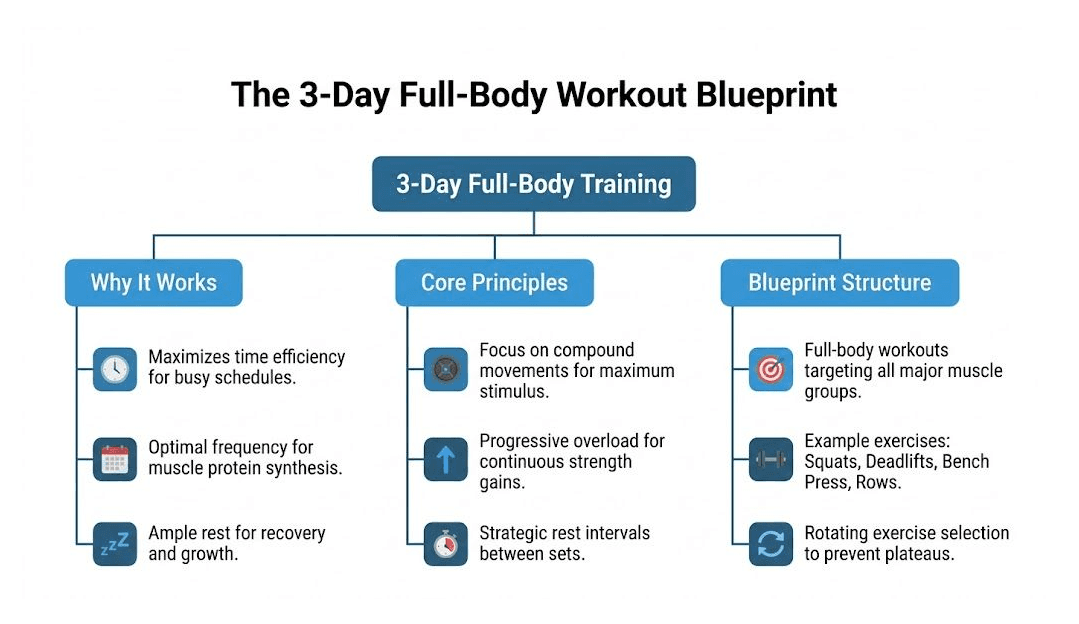
Each session takes roughly 45–50 minutes including warm-up. That's under 2.5 hours per week of total gym time. For a complete breakdown of the 3-day gym routine with exercise swap options and travel workouts, see The Best Gym Routine for Busy Professionals.
Why This Split Works
- Every muscle hit 2–3× per week — optimal frequency for hypertrophy
- Compound lifts first — biggest bang for your time
- Balanced push/pull/squat/hinge — prevents imbalances and injuries
- Built-in variation — the A/B alternation prevents boredom and overuse
Progressive Overload: How to Keep Getting Stronger
The programme only works if you progressively overload. That means gradually increasing the demand on your muscles over time.
Without progressive overload, your body has no reason to adapt. You'll maintain what you have but won't gain anything new.
The Simple Progression Model
- Week 1: Hit the prescribed sets and reps with a weight that leaves 1–2 reps in reserve.
- Week 2: If you hit all reps cleanly, add 2.5kg to upper body lifts or 5kg to lower body lifts.
- If you stall: Stay at the same weight until you complete all prescribed reps across all sets. If you stall for 2 sessions in a row, deload by 10% and rebuild.
This is called linear periodisation, and for anyone in their first 1–2 years of serious lifting, it's the fastest way to get strong.
Other Ways to Overload
Adding weight to the bar isn't the only option. Here are other forms of progressive overload that work within this programme:
| Method | Example |
|---|---|
| More reps | 3×8 → 3×10 at the same weight |
| More sets | 3 sets → 4 sets (add 1 set per cycle) |
| Better form | Same weight, fuller range of motion |
| Slower eccentrics | 3-second lowering phase on each rep |
| Less rest | Same work done in less total time |
The goal is measurable progress. If you're not tracking, you're guessing. Write down your weights, reps, and how each set felt. That's the difference between someone who trains for years with nothing to show for it and someone who transforms in 12 weeks. (Bony to Beastly)
Nutrition: Fuel the Gains
Training is the stimulus. Nutrition is what turns that stimulus into muscle.

Calories
- To build muscle: Eat at maintenance or a slight surplus (+200–300 kcal above TDEE)
- To lose fat & build muscle (recomp): Eat at a mild deficit (−300–500 kcal) with high protein. This works especially well for beginners and returning lifters.
- To lose fat: Eat at a moderate deficit (−500 kcal) — see our full guide: How to Lose 10kg in 12 Weeks
Protein
Aim for 1.6–2.2g of protein per kg of bodyweight per day. For an 85kg man, that's roughly 140–185g.
A 2022 meta-analysis in Sports Medicine confirmed that protein intakes above 1.6g/kg/day maximise muscle protein synthesis when combined with resistance training (Morton et al.). For a complete deep dive, read How Much Protein Do You Need to Lose Fat and Keep Muscle?
Meal Timing (Simplified)
- Pre-training: A balanced meal 1–2 hours before. Protein + carbs.
- Post-training: A protein-rich meal within 2 hours after. The “anabolic window” is real but wider than the industry claims — you have 3–4 hours, not 30 minutes.
- Total daily intake matters more than timing. If you hit your protein and calorie targets, meal timing is a fine-tuning detail, not a make-or-break factor.
Recovery: Where the Magic Happens
You don't grow in the gym. You grow between sessions. And for most busy men, recovery is the weakest link.
Sleep
Aim for 7–9 hours per night. Growth hormone release peaks during deep sleep. Chronic sleep restriction (under 6 hours) has been shown to reduce testosterone by up to 15% and impair muscle protein synthesis (Leproult & Van Cauter).
Stress Management
Cortisol — your body's primary stress hormone — is directly catabolic to muscle tissue. Chronic stress = chronic cortisol = impaired recovery.
The fix isn't meditation apps (although those help). The fix is building a training programme that fits your life without adding stress. Three sessions per week, locked in your calendar, is inherently less stressful than trying to squeeze in 5–6 and failing. Read more: Why Strength Is a Career Asset for Executives
Rest Days
With a 3-day programme, you have 4 rest days per week. Use them:
- Walk: 8–10,000 steps. Low intensity, high recovery benefit.
- Stretch: 10 minutes of hip flexor and thoracic mobility work. Your desk job is wrecking both.
- Don't: Add “bonus” sessions. The programme is designed around 3 days. Adding more disrupts the recovery balance.
5 Common Mistakes That Kill Your Progress
1. Programme Hopping
Switching routines every 2–3 weeks because you saw something on Instagram. Adaptations take 4–6 weeks to manifest. Stick with this programme for at least 12 weeks before evaluating.
2. Ego Lifting
Loading too much weight and using momentum instead of muscle. Every rep should be controlled. If you can't lower the weight slowly (2–3 seconds), it's too heavy.
3. Skipping Legs
Squats and deadlifts are the highest-ROI exercises in your programme. They recruit the most muscle mass, burn the most calories, and drive the biggest hormonal response. Skipping them is leaving 60% of your results on the table.
4. Neglecting Protein
Training without adequate protein is like building a house without bricks. If you're under 1.6g/kg, your muscles literally don't have the raw materials to grow.
5. No Tracking
If you don't write down what you lifted, you can't progressively overload. Period. Use a notebook, a phone app — it doesn't matter. Just track.(Zing Coach)
What to Expect: Month by Month
| Timeframe | What Happens |
|---|---|
| Month 1 | Neural adaptations. You get stronger quickly as your nervous system learns the movements. Expect big jumps in weight on the bar. |
| Month 2 | Visible changes begin. Clothes fit differently. Shoulders broaden. Waist tightens (if nutrition is on point). |
| Month 3 | Other people notice. Your compound lifts are significantly stronger. Body composition has visibly shifted. You've built the habit. |
For a realistic 12-week timeline, see Why 12 Weeks Is the Ideal Timeframe for a Body Transformation.
The Bottom Line
Three days a week is not a limitation. It's a feature.
It gives you enough volume to grow, enough frequency to maximise protein synthesis, and enough recovery to come back stronger each session. It fits into a busy life without requiring you to reorganise your entire week around the gym.
The programme above is the exact structure we use with clients at Vantage Performance. Compound lifts, progressive overload, adequate protein, and relentless consistency.
That's it. No shortcuts. No secrets. Just a system that works — if you work it.
Ready to start? Our 12-week coaching programme builds this system around your schedule, your goals, and your life. Training, nutrition, and accountability — all for $250/month.
Apply Now