What 25% Body Fat Looks Like on Men: A Visual Guide
You notice it in small moments first. Your navy suit still buttons, but it pulls across the stomach when you sit. The shirt that used to skim your torso now bunches at the waist by mid-morning. By late afternoon your energy drops harder than it used to, and long travel days feel more expensive than they should.
That's when men start searching for what 25% body fat looks like on men. Not because they're chasing a six-pack. Because they want a clear read on whether what they're seeing is normal drift, or a sign that their current system has stopped working.
For busy executives, founders, and senior professionals, 25% body fat is often the point where “a bit out of shape” turns into something more consequential. It changes how you look in clothes, how you feel in a workday, and how much capacity you have left when the schedule gets crowded. The good news is that it's still fixable. The wrong move is treating it like a motivation problem. It's a systems problem.
The 25% Body Fat Threshold: Why It Matters for Men
You notice it on a Monday morning when your suit pulls tighter across the waist, your energy drops by mid-afternoon, and the workout you used to fit in before work keeps getting pushed to “later.” That is how 25% body fat shows up for a lot of busy professionals. Not as a crisis. As friction.
This threshold matters because it usually marks the point where excess body fat stops being a cosmetic issue and starts affecting how you feel, how you perform, and how consistently your routine holds up under pressure. In common body fat classification systems, 25% is widely treated as the line where men move into a higher-risk category, with somewhat higher cutoffs used for older age groups in some references.
For a high-performing man, the practical cost is straightforward. Clothes fit worse. Travel feels harder on the body. Energy becomes less stable. Training stops producing visible returns because the system around it is breaking down.
The pattern I see most often
This rarely happens because someone stopped caring. It happens because work expands and structure disappears.
The profile is predictable:
- Responsibility increases: More meetings, more travel, more decisions, less control over the day.
- Training loses its slot: Lifting gets replaced by random cardio, skipped sessions, or hotel gym guesswork.
- Food becomes reactive: Business dinners, airport meals, late eating, and portion creep start driving calories up.
- Recovery slips: Sleep shortens, alcohol becomes more frequent, and weekends turn into catch-up mode.
A single week like that does not do much. Six months does.
What makes 25% useful as a marker is that it gives you an early operational warning. If your waist is expanding, your shirts fit differently, and your energy is less reliable, the answer is not more willpower. The answer is a system that still works during busy weeks, travel weeks, and high-stress quarters.
That is the highest-return move for fat loss. Fix the schedule, food defaults, and training structure first. Then body fat starts moving in the right direction. If you want practical examples of that approach, the fat loss articles here are a good place to start.
The Visual Evidence: What 25% Body Fat Looks Like
A lot of men first notice 25% body fat in a changing room, not the gym. The suit still works from the front. Then the shirt pulls across the stomach when they sit, the jacket hangs wider through the waist, and photos from a work event show a softer frame than expected.
At 25% body fat, the visual shift is clear even if day-to-day clothing hides some of it. Muscle separation is mostly gone. The shoulders look rounder than capped. The chest loses firmness. The waist thickens, and the midsection becomes the dominant feature of the physique.
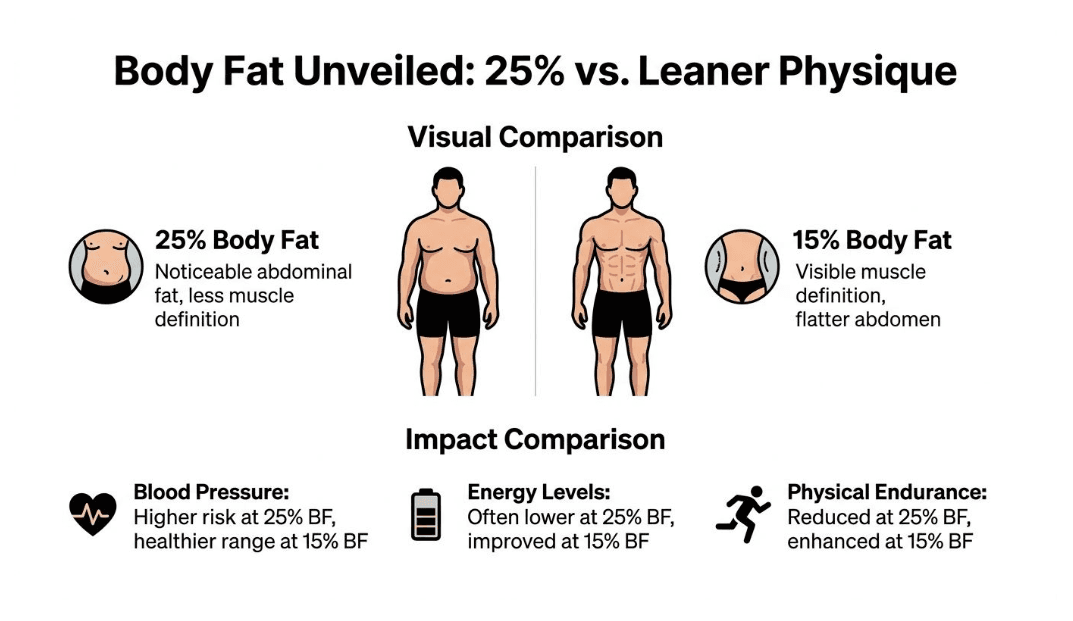
How it usually presents
This is a body-fat range that often looks better dressed than undressed. That matters for professionals, because custom-fit clothes can hide a lot of change until the waist crosses a line.
Without that cover, the pattern is consistent. The abdomen looks soft or sticks out. Fat collects around the beltline and flanks. The arms may still appear thick, especially if the man has lifted before, but shape and definition are limited. There is usually no visible separation in the shoulders, arms, or abs.
| Area | What you typically see at 25% |
|---|---|
| Midsection | Rounded stomach, thicker waist, fat storage around the beltline |
| Chest | Softer appearance, less structure through the upper torso |
| Arms and shoulders | Some size may remain, but little visible definition |
| Lower back and flanks | Love handles are visible |
| Overall look | Soft, average-looking, no longer clearly athletic |
I see one mistake all the time here. Executives compare themselves to the heaviest version of obesity and assume they are doing fine because they do not look extreme. That is the wrong comparison. The useful comparison is whether your body still reads as capable, sharp, and trained, or whether it now reads as overworked and under-managed.
What 25% looks like compared with leaner levels
The visual difference between 25% and 15% is not bodybuilding detail. It is shape.
- At 25%: The waist is thicker, the stomach is softer, and muscular features are blurred.
- At 20%: The body still looks soft, but the midsection is flatter and the frame looks tighter in clothes.
- At 15%: The waist is noticeably leaner, some abdominal outline may show, and the body looks trained.
That is why this range catches busy men off guard. In a navy suit, you can still look put together. On a beach, in gym lighting, or in an untucked dress shirt after dinner, the extra fat is obvious.
Many men underestimate body fat because work clothes hide changes in the waist for months.
The practical takeaway is simple. At 25%, the body usually looks less athletic, less defined, and less sharp than the owner thinks it does. For a high-performing professional, that shows up in more than the mirror. It shows up in how clothes fit, how confident you feel walking into a room, and how far your appearance has drifted from the standard you expect of yourself.
Beyond the Mirror: The Hidden Health Risks
The bigger issue at 25% isn't what you can see. It's where the fat is sitting.
For men, fat storage tends to concentrate around the midsection and organs. That's why some men at this level don't have a soft, pinchable stomach. They have a firmer, protruding abdomen that looks more like a barrel than a loose belly.

Why the belly looks different
That shape reflects visceral fat accumulation rather than just subcutaneous fat.
FitCommit's body composition breakdown gives a concrete example. For a 5'10”, 180 lb male at 25% body fat, lean mass totals 135 lbs and fat mass totals 45 lbs. The same analysis notes that this pattern creates a hard, protruding abdomen, the classic “beer belly,” and indicates increased metabolic risk.
That distinction matters.
Subcutaneous fat is the fat under the skin. It changes how you look. Visceral fat surrounds internal organs. It changes how your body functions. From a coaching standpoint, that's the more important problem to solve.
What matters more than appearance
Busy professionals make a mistake here. They judge urgency by aesthetics.
If they don't look overweight, they assume they have time. But the men who struggle most are not the visibly heaviest. They are the ones who still look “big” or “solid” in clothes, while carrying more abdominal fat than they realize.
A few practical signs show up together:
- Your stomach feels firm: Not just soft.
- Your waistline keeps drifting: Especially around formal trousers and custom-fit shirts.
- You tire earlier in training: The engine isn't what it was.
- You recover poorly: Hard sessions or poor sleep hit harder than before.
The belly you can hide under a shirt is the least important part of the problem. The location of the fat matters more than the visibility of it.
This is why random cardio bursts and crash diets fail. They treat fat loss like a calorie math problem only. For men at this level, the goal is to reduce total fat while preserving or rebuilding lean tissue, improving how the body partitions energy, and lowering the central fat storage that drives the worst downstream effects.
How 25% Body Fat Impacts Your Professional Life
Most articles stop at mirror talk. That misses the true cost.
At 25% body fat, the issue isn't just that you look softer. It's that your body starts imposing friction on work that already demands a lot from you.

Executive presence takes a hit
Clothes tell the story fast.
Jackets pull at the button stance. Trousers sit tighter at the waist. Shirts tent at the midsection and collapse at the chest. None of that ruins a career. But it does affect how you carry yourself, how relaxed you feel in front of a room, and how much you become aware of your body when your attention should be on the conversation.
That erosion is subtle. So is the loss of confidence that comes with it.
For professionals who are used to being sharp, composed, and in control, physical self-consciousness is a tax. It sits in the background during presentations, dinners, photos, and travel. That's one reason the idea of strength as an executive asset resonates with a lot of leaders. The body isn't separate from performance. It supports it.
Performance costs show up before a diagnosis
Kubex notes that at 25% body fat, muscle definition becomes imperceptible, which can create a deceptive appearance in clothed settings that masks metabolic vulnerability. The same source adds that men at this threshold experience reduced stamina during exertion and borderline cardiovascular fitness markers.
That lines up with what professionals report in plain language:
- Meetings are fine, but long days feel heavier.
- Travel is more draining.
- Evening focus drops.
- Training feels harder than it should.
- Recovery from poor sleep gets worse.
You can still be productive in that state. Plenty of men are. The issue is efficiency. Everything costs more effort.
You don't need to be clinically ill for excess body fat to lower the quality of your workday.
That's why fat loss at this level is best framed as performance maintenance, not vanity. Better suit fit is a bonus. More stable energy, stronger training capacity, and better resilience under pressure are the true return.
The System for Reversing Course: From 25% to 15%
The men who make the fastest durable change don't overhaul their whole lives. They remove what doesn't work, install a few high-return behaviors, and repeat them long enough for body composition to move.
That's the job. Not motivation. Not punishment.

The strongest evidence-backed approach here is resistance training, not more cardio. According to Ultimate Performance, men at 25% body fat who move to a healthier range through 3×45-minute resistance training sessions can lose 10 to 15 kg without muscle catabolism, with biomarkers improving 30% faster than cardio-alone protocols.
That's why the most impactful system is built around lifting, not endless calorie burn.
Phase 1: Strip out what fails
Most busy men are running a fat-loss strategy that looks disciplined but performs badly.
It includes some mix of:
- too much cardio,
- inconsistent strength work,
- weekdays that are overly restrictive,
- weekends that erase the deficit,
- and nutrition rules that collapse during travel.
What fails first should go first.
Cut the “earn your food” mindset. Cut the idea that a few hard sweat sessions can offset poor structure. Cut meal plans that require perfect conditions.
The first win is simplification. You want fewer decisions, not more.
A better base looks like this:
- Training gets scheduled first: Fixed slots in the calendar, like board meetings.
- Food rules get portable: Meals you can execute at home, in hotels, or at restaurants.
- Alcohol becomes deliberate: Not automatic.
- Recovery gets protected: Because poor sleep drives worse decisions.
Phase 2: Build momentum with efficient training
Many executives waste time during this phase.
They assume fat loss requires long sessions, daily gym visits, or punishing circuits. It doesn't. A tighter approach works better because it's easier to sustain under pressure.
The anchor is simple: three sub-45-minute strength sessions per week.
That structure fits around a demanding schedule and gives enough stimulus to preserve or build lean mass while body fat comes down. In practice, the sessions should revolve around compound lifts and straightforward progression. Squats, hinges, presses, rows, carries. Nothing fancy. No novelty for its own sake.
Here's the standard I use:
- Keep sessions short enough to be repeatable. If the plan only works on calm weeks, it isn't a plan.
- Train hard, not endlessly. A focused strength session beats a longer, lower-quality one.
- Use cardio sparingly. Walking and light conditioning are useful. Chronic cardio as the primary tool usually isn't.
This kind of training also changes how men look faster than cardio-led plans. As the waist comes down, muscle shape reappears. That matters for aesthetics, but it also matters because it preserves the body that makes staying lean easier later.
Phase 3: Lock in a repeatable operating system
The final phase is where most rebound happens. Men lose weight, then drift back because nothing about the week was redesigned.
The solution isn't intensity. It's infrastructure.
A sustainable operating system includes:
| Constraint | Better response |
|---|---|
| Client dinners | Order around protein and keep the meal simple |
| Flights and hotels | Use repeatable default meals instead of improvising |
| Unpredictable days | Protect the minimum effective workout, not the ideal workout |
| Stress spikes | Avoid turning food and alcohol into the recovery plan |
Coach's note: The best plan is the one that still works on your busiest Wednesday, not the one that looks impressive on paper.
That's how you move from 25% toward 15% without acting like a full-time athlete. The body changes because the system finally fits the life.
Taking Control Before It Becomes a Bigger Problem
By the time most men act, they've spent too long negotiating with obvious evidence.
The clothes fit worse. Energy is less reliable. Training feels flat. Photos look older than they should. None of that means you've failed. It means the current system has reached its limit.
At 25% body fat, you still have a workable problem. That's the key point. This is early enough to reverse cleanly if you stop treating it casually.
A high-performer wouldn't ignore a failing business process and hope willpower fixes it. He'd diagnose the bottleneck, install a better operating model, and track execution. Body composition works the same way. You don't need drama. You need structure.
That structure should be time-efficient, boring enough to repeat, and strong enough to survive travel, pressure, and imperfect weeks. If it depends on ideal conditions, it won't last. If it preserves muscle, manages food effectively, and fits inside an executive schedule, it has a chance.
The goal isn't to become obsessive. The goal is to stop leaking energy, confidence, and health through a problem you can solve.
Use the number for what it is. Not a label. A signal.
If you're at this point, now is the right time to act, before “a bit soft” becomes the new normal and then becomes something harder to unwind. If you want expert support built specifically for busy professionals, online weight loss coaching for executives and founders is the logical next step.
Vantage Performance helps founders, executives, and senior professionals lose fat without blowing up their calendar. If you want a private, evidence-based system built around sub-45-minute training, flexible nutrition for dinners and travel, and direct 1-to-1 coaching, visit Vantage Performance.