What Causes Hamstring Cramps? A Founder's Guide
That cramp isn't random bad luck. It's a system failure — and your schedule is creating the exact inputs that make it happen.

You're on a flight after two bad nights of sleep, too much coffee, not enough water, and a rushed airport workout squeezed in before boarding. You shift in your seat and your hamstring grabs hard. Or it happens during a rare strength session, right as you hit a bridge or sprint interval. Or you stand up after a long board meeting and feel that familiar warning twitch.
Many treat that as random bad luck. It isn't.
To understand what causes hamstring cramps, stop thinking of the cramp as the problem. Treat it as a signal. Your body is telling you that one or more systems — hydration, movement quality, tissue tolerance, recovery, or posture — stopped coping with the load you gave them.
That matters for executives because your schedule creates the exact inputs that make cramps more likely. Long sitting. Frequent travel. Irregular meals. High stress. Intense training packed into narrow windows. The cramp is often the first visible sign that your physical operating system is running below capacity.
That Sudden Hamstring Cramp Is a System Failure
A hamstring cramp rarely shows up without context. It usually appears after a chain of small misses.
You sit most of the day. You rush into training. You skip the warm-up because time is tight. You're a little dehydrated from meetings, flights, or alcohol the night before. Then the hamstring locks up and steals the session.
That isn't a muscle acting out for no reason. It's a system failure under pressure.
The cramp is the dashboard warning light
Think about how high performers usually respond. They grit through it, stretch aggressively for a short period, then carry on as if the event means nothing. That approach works about as well as taping over a warning light in a car.
A hamstring cramp points to one of a few likely breakdowns:
- Hydration and electrolyte mismatch: You lost more through sweat and travel than you replaced.
- Fatigue overload: The muscle and nervous system hit a threshold and lost control.
- Bad movement substitution: The hamstring did work the glutes or trunk should've handled.
- Postural drift: Hours of sitting changed the position and tension your body can manage.
Practical rule: If a cramp appears more than once, assume there's a repeatable trigger and start tracking it.
I see the same mistake often. Busy professionals want the smallest effective training dose, which is smart. But when they compress effort into very tight windows without respecting setup, they create conditions where the session is efficient on paper and sloppy in practice. That's why a minimum effective dose strategy only works when the basics are in place first, as outlined in this guide on minimum effective dose gym training for busy professionals.
Random is usually just untracked
Most cramps feel sudden. Very few are out of nowhere.
If you log when they happen, a pattern usually shows up. Same exercise. Same travel day. Same sleep-deprived state. Same point late in the session. Same side. Same cramped position after sitting for hours.
That pattern is useful. It tells you where your system stops coping.
The Neurological Glitch Behind Most Cramps
The biggest misconception around what causes hamstring cramps is that it's always just about low minerals. Electrolytes matter, but the main event is often neuromuscular breakdown.
Your hamstring cramps when the signals controlling contraction and relaxation stop staying coordinated. Instead of turning on and off cleanly, the muscle gets hit with excessive motor nerve firing and locks into an involuntary contraction. StatPearls describes exercise-associated cramping as arising from excessive firing of motor nerves, with triggers that can include electrolyte imbalance, metabolic disturbance, or nerve compression, and notes that hamstrings are especially vulnerable in activities like running that involve sudden deceleration (NCBI StatPearls on muscle cramps).
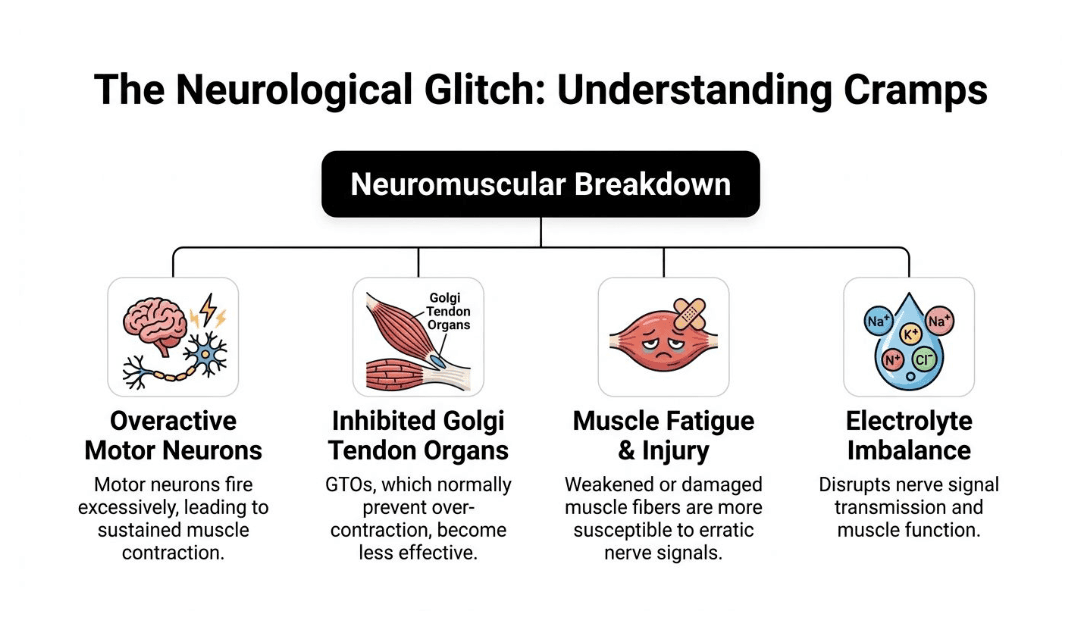
A cramp is an overfiring problem
At a practical level, a cramp is a control problem.
Your nervous system is supposed to regulate force. It should let the hamstring contract hard when needed, then relax when the task changes. Under fatigue or poor mechanics, that control gets noisy. The muscle stays switched on when it should back off.
That's why cramps show up in conditions like these:
- Late in a session: Fatigue lowers control.
- After repeated hard efforts: The nervous system gets less precise.
- During sudden deceleration or sprinting: Hamstrings absorb force fast.
- When a muscle is already irritated or overloaded: The threshold for spasm drops.
A cramp isn't just “tightness.” It's the nervous system losing the ability to meter tension properly.
Why the hamstring is an easy target
The hamstring is vulnerable because it crosses both the hip and knee. It has to coordinate with the glutes, pelvis, trunk, and lower leg while handling force across changing joint angles. That's a lot of demand for one area, especially when you've spent the day seated.
It becomes even more obvious in exercises that are supposed to train the glutes. If the glutes don't contribute well, the hamstrings often step in. They try to finish the task from a poor position and then seize.
The cramp isn't proof that the hamstring is weak by itself. It often means the rest of the chain handed it a job it wasn't set up to do.
That distinction matters. If you treat every cramp as a hydration issue, you miss the movement issue. If you treat every cramp as a movement issue, you miss the fatigue or electrolyte issue. Good coaching separates those.
What works is identifying the context. Did the cramp happen in a bridge, sprint, deadlift, long flight, or after a hot session? Each points to a different failure point.
Why Executives Are Uniquely at Risk
Executives don't just train under physical stress. They train under logistical stress.
That changes the risk profile. Your hamstrings aren't only dealing with workouts. They're dealing with sitting, rushing, travel, inconsistent hydration, and the kind of stress that makes people override obvious recovery signals.

Sitting changes the position you train from
For desk-bound professionals, posture is a major input. Research focused on sedentary work points to anterior pelvic tilt and related postural issues as contributors to chronic hamstring weakness and cramping, noting that over time “pain will develop through the hamstring tendon and musculature due to a weakened hamstring muscle” (discussion of posture-related hamstring pain and weakness).
The key idea is simple. If you sit for long stretches, your body adapts to that position. Then you ask it to produce force quickly in a workout.
That creates a mismatch:
- The pelvis may sit in a poor position.
- The trunk may not stabilize well.
- The glutes may stay under-recruited.
- The hamstrings may feel “tight” but be overworked and poorly controlled.
A lot of high performers misread this. They feel tension in the hamstring and assume they need more stretching. Sometimes they need less random stretching and more positioning, activation, and strength in the right places.
Travel and stress remove your margin for error
Travel shrinks your buffer. Flights, hotel beds, restaurant meals, dehydration, and low movement all stack up. You can still train well, but you no longer have much room for sloppy setup.
Stress adds another layer. When someone's operating under constant pressure, they often hold more baseline muscle tension, sleep worse, and make worse decisions around hydration, food, and recovery. None of that guarantees a cramp. It just makes the system less resilient.
That's why strength should be treated as an executive asset, not a side hobby. It protects output. It supports travel tolerance. It makes your body less fragile when work gets chaotic. This is the same reason strength functions as an executive asset, not just a fitness goal.
If your hamstring cramps during a simple session, don't only ask what happened in the gym. Ask what happened in the previous forty-eight hours.
That usually provides the answer.
Immediate Relief When a Cramp Strikes
When a hamstring cramp hits, your goal isn't to be tough. Your goal is to stop the spasm fast and regain control without making it worse.
Start with this.
Use this three-step reset
Step 1. Change the position slowly.
Lengthen the hamstring gently. If you're seated, extend the knee a little and hinge forward slightly without forcing range. If you're standing, place the heel on a low surface and soften into a mild stretch.
Step 2. Apply pressure to the muscle belly.
Use your hands, a massage ball, or the edge of a chair if needed. Firm pressure can help the muscle downshift. Don't jab at the tendon behind the knee. Stay in the thicker part of the muscle.
Step 3. Slow your breathing.
Take controlled exhales and stop panicking your way through it. A cramp often gets worse when you tense everything around it.
Here's the operating rule:
- Gentle beats aggressive: Pulling hard on a cramping muscle often increases guarding.
- Stillness beats thrashing: Sudden movements can keep the spasm alive.
- Control beats speed: You're trying to calm the signal, not win a fight with the muscle.
What not to do in the moment
People waste time on the wrong response.
Don't do this:
- Don't sprint back into the set: The tissue and nervous system haven't reset yet.
- Don't mash the area violently: More pain isn't better treatment.
- Don't assume one electrolyte drink fixes everything: If the trigger was positional or fatigue-based, that won't solve the immediate issue.
- Don't ignore the after-effect: A cramp that leaves lingering tightness means you need to modify the rest of the session.
If it releases, great. Reduce load, change the exercise, or end the session. The right call is the one that prevents the second cramp.
The cramp wants a lower-threat environment. Give it one. A short demo can help if you're trying to picture the mechanics of relaxing the area and regaining position:
Building Your Cramp-Proof System
If you keep asking what causes hamstring cramps but only look for a single cause, you'll stay stuck. Most recurring cramps come from a stack of small failures. The fix is a system.
Fix the sequence before you add intensity
One of the most common examples is glute-focused training that turns into hamstring-dominant training. In bridge patterns and similar movements, the hamstrings can cramp because they're trying to compensate for weak or poorly recruited glutes. In shortened positions, the hamstring's length-tension relationship is not optimal, which can trigger cramping instead of productive work.
That means prevention starts before the working sets. A useful pre-session sequence:
1. Get out of the desk posture
- Walk for a few minutes
- Open the hips
- Move the spine and pelvis through easy range
2. Wake up the glutes
- Bodyweight bridge holds
- Split-stance glute work
- Banded lateral work if you have a mini band
3. Rehearse the main pattern
- Do a low-load version of the movement you're about to train
- If the hamstrings start taking over early, regress the exercise
If a bridge cramps your hamstring every time, more determination isn't the answer. Better sequencing is.
Hydration has to match your schedule
Hydration advice fails busy professionals because it's usually too generic. “Drink more water” is incomplete. The historical foundation for electrolyte-related cramps came from industrial workers in the 1920s and 1930s. Research on miners, ship's stokers, construction workers, and steel mill workers found that saline drinks or salt tablets greatly reduced cramp incidence, especially in workers losing large amounts of sweat during physically demanding shifts. Those studies helped establish the water-and-salt-balance view that still shapes cramp management today (historical review of sweat, salt loss, and muscle cramping).
For executives, the implication is practical. Water matters, but on travel days, hot training days, and long meeting days, you may also need sodium replacement, not just plain fluid.
Useful options include products like LMNT, Liquid I.V., or other electrolyte packets that are easy to carry in a backpack or briefcase. The product matters less than the habit. If your day includes flights, caffeine, sweat, and a hard workout, don't wait until the cramp hits to think about fluids.
Food matters too. If your nutrition is chaotic, your training tolerance usually follows. A structured plan that can flex around work dinners and airports is far more effective than trying to improvise under pressure. A practical executive meal plan built for real schedules becomes useful.
Your weekly executive cramp prevention system
Here's the version that works in real life.
| Pillar | Daily Action (5–10 min) | Weekly Action | Why It Works |
|---|---|---|---|
| Position | Walking breaks, reset hip position after sitting | Start lower-body sessions with mobility and rehearsal sets | Reduces desk-to-training posture mismatch |
| Activation | Short glute activation before key sessions | One block of glute-focused accessory work | Lowers hamstring compensation |
| Hydration | Pre-load fluid and electrolytes on travel days | Review which sessions trigger cramps, adjust intake | Matches replacement to real sweat and schedule demands |
| Load management | Stop chasing intensity when sleep is poor | Swap aggressive hinge volume for lower-threat options | Cuts fatigue-driven neuromuscular breakdown |
| Recovery | Light movement after flights and long meetings | At least one lower-intensity or recovery block per week | Keeps the nervous system responsive |
A few trade-offs matter here.
What works
- Short activation before training
- Electrolytes when sweat loss or travel is high
- Regressing exercises that repeatedly trigger cramps
- Training hard on days your body can absorb it
What doesn't
- Stretching the hamstring harder every day without fixing mechanics
- Drinking plain water only and assuming that covers everything
- Ignoring travel fatigue
- Treating repeated cramps as a motivation problem
The goal isn't to eliminate all discomfort. The goal is to build a body that doesn't keep sending the same warning signal.
Red Flags: When a Cramp Is More Than a Cramp
Most hamstring cramps are self-limiting. They hurt, they disrupt the day, then they pass. But some cases need medical evaluation.
When to stop self-managing
Get assessed if any of the following show up:
- The pain doesn't settle: A normal cramp should ease with simple measures. If pain stays high or keeps returning quickly, look deeper.
- You have ongoing weakness: If the leg feels unreliable or noticeably weaker afterward, that may be more than a cramp.
- There's swelling, discoloration, or unusual warmth: Those signs need proper medical attention.
- It happens without obvious exertion: Recurrent cramps at rest deserve a closer look.
- You notice numbness or other unusual symptoms: That changes the picture.
A true cramp is one thing. A strain, nerve issue, or circulation problem is another.
Why this matters if you train hard and recover poorly
The reason this line matters is simple. High performers are good at normalizing warning signs.
You tell yourself it's just tightness. You train through it. Then the pattern repeats until the tissue is more irritated, your mechanics get worse, and you lose training continuity.
The older evidence on industrial workers is useful here because it reminds us that cramps can have a real sweat and salt component, and that replacing those losses helped reduce cramp incidence in demanding environments. But even with that foundation, not every cramp is just a hydration issue. If the situation doesn't respond like a routine cramp, stop guessing and get it checked.
The fastest way back to consistent training is an accurate diagnosis, not more trial and error.
If hamstring cramps keep interrupting your training, travel, or day-to-day performance, Vantage Performance helps founders and executives build a body that holds up under real-world stress. The coaching is private, data-driven, and designed for demanding schedules — so you can fix the system behind the symptom instead of managing the same problem on repeat.
Unlock VIP Coaching Now